
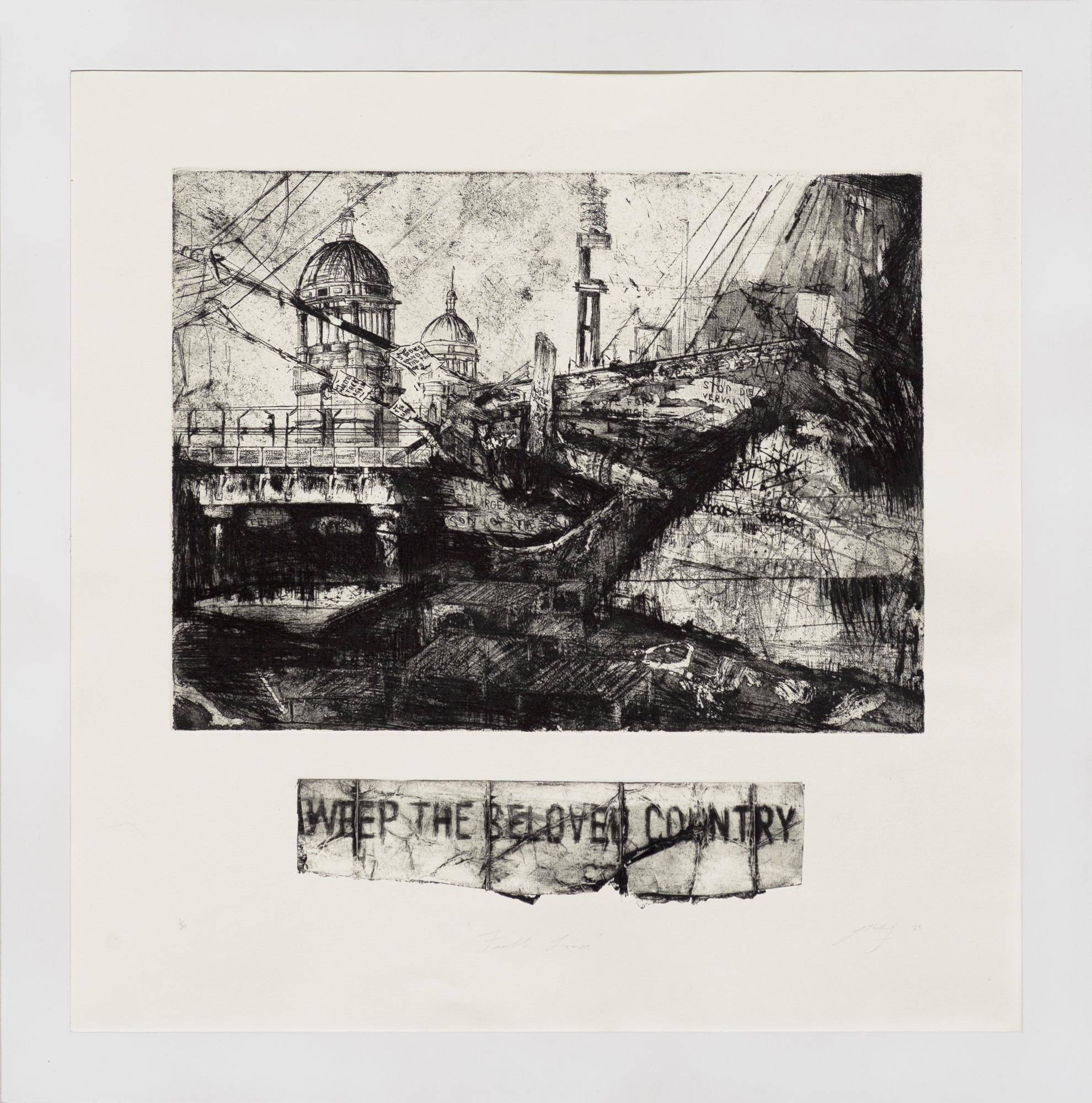
Fault lines
Etching and Drypoint on Hahnemühle
Edition 1 of 30
57,5 cm x 57,5 cm
Artist’s Statement
This etching, titled Fault Lines, explores the layered realities of decay — both physical and societal — within contemporary South Africa. The work serves as a visual lament and a critical reflection on a country shaped by deep-rooted inequalities, fading infrastructures, and the lingering shadows of its colonial and apartheid histories.
Etching, with its inherently corrosive process, offers a metaphor for the erosion of structures, whether they be social, political, or material. I deliberately embraced the medium’s unforgiving nature: each line etched into the metal plate feels permanent, like the entrenched scars left on a nation struggling to redefine itself. The act of biting into the plate with acid mirrors the slow, often invisible forces that corrode public trust, economic stability, and communal hope. This technique allowed me to physically engage with themes of erosion, abrasion, and time, embedding them directly into the texture of the work.
Visually, Fault Lines presents a fractured landscape. Architectural remnants — broken highways, derelict public housing — emerge alongside symbolic representations of decay: rusted fences, power lines sagging under neglect, spaces caught mid-transition between presence and absence. These motifs are not just literal representations of urban decline but also act as metaphors for the collapse of ideals and promises made in the post-apartheid era. South Africa’s cities and townships, once vibrant with hope, now often stand in stark contrast to the vision of transformation they were meant to embody.
The social climate in South Africa today is marked by growing disillusionment, inequality, and a profound sense of waiting for justice, for change, for accountability. This etching captures that stillness, the haunting silence between protest and reform.
I was particularly influenced by the contrast between decay and persistence. While the infrastructure may falter and institutions fail, communities continue to adapt, survive, and resist.
Fault Lines is not meant to offer solutions but to provoke engagement. It is a call to witness — to see the uncomfortable truths often hidden behind statistics and political rhetoric. As an artist, I believe in the responsibility of holding space for nuance, grief, and reflection. Through this work, I invite viewers to confront the uncomfortable reality of a nation in flux.