

Artwork Details
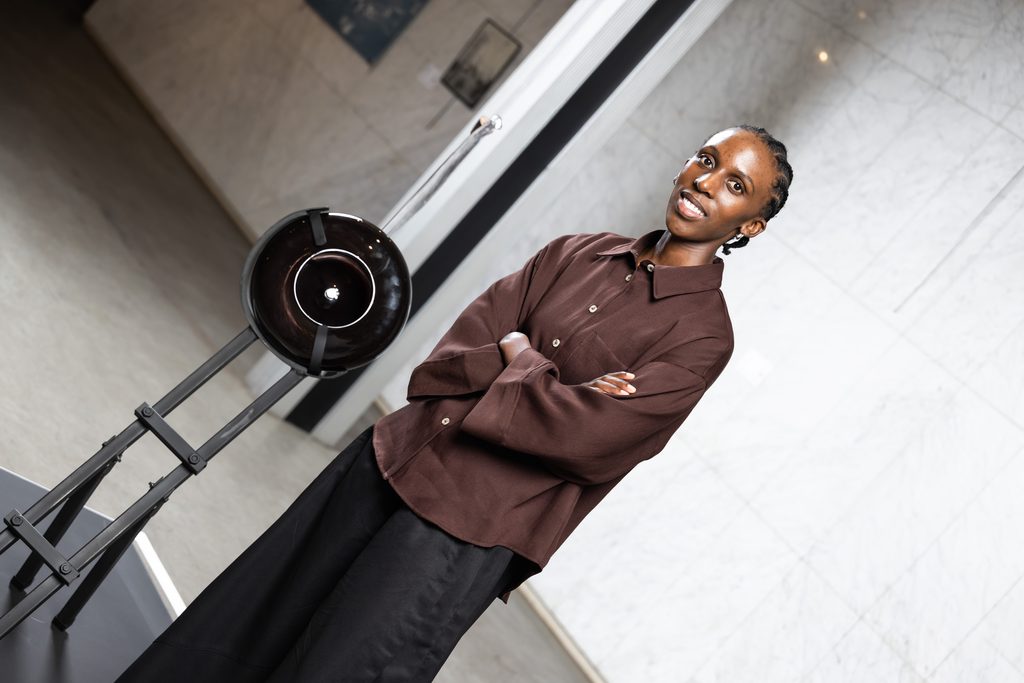
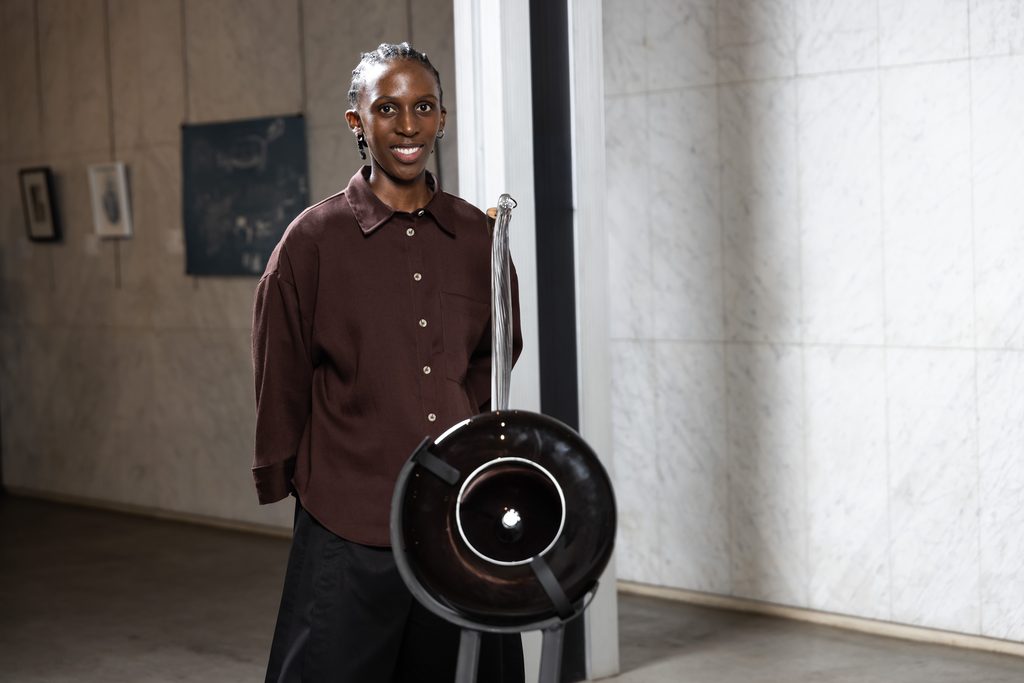
Qula kwedini, 2025
Glass, metal, wood
Artist Biography
Inga Lokwe is a glass sculptor and contemporary artist, as well as a part-time lecturer specialising in Glass. She is currently completing her master’s degree at Tshwane University of Technology in Pretoria. Her practice has taken her across local and international platforms, with participation in numerous exhibitions, conferences, artist talks at Wheaton’s conversation programme and at Salem Community College, and residencies.
In 2024, she completed an internship at Wheaton Arts in New Jersey, USA, and was subsequently awarded a residency there in 2025. She attended the Pilchuck Youth Conference in Seattle, Washington, and was a finalist for the Sasol New Signatures exhibition at the Pretoria Art Museum. Her work is currently exhibited in Cape Town at Berman Contemporary as part of All Women Art. Recent exhibition highlights include Berman Contemporary (2024, 2025), Pretoria Art Association (2025), and Exploring Visual Cultures (International Group Exhibition, Javett Art Centre, 2024). Her work will be exhibited at the Museum of Glass in America in 2026 as a collected artwork. Inga has collaborated with local and international artists.
Q&A
Tell us what your reaction was when you received the news that your work had been
I was genuinely surprised and quite overwhelmed. For a moment, I had no words. All I could say was, “Thank you.” It was a humbling experience, and I felt immense gratitude. To have the work recognised in this way means more to me than I can easily put into words.
Is this your first time entering Sasol New Signatures? If so, what prompted you to enter? If not, how many times have you entered, and what keeps bringing you back to the competition?
This was my second time entering the competition. What brought me back was the confidence I had slowly developed in my skills and my relationship with glass.
After entering in 2023, I was fortunate to be placed in the Top 100. Although I didn’t enter again immediately, I used those two years to work on myself, develop my practice, and become more confident in my abilities. I wanted to return when I felt that I had grown not only as an artist, but also in my understanding of what I wanted to say through glass. So, coming back this year felt like an important personal moment. I was ready to challenge myself again and see where all those years of learning and persistence could take me.
As South Africa’s longest-running art competition, what does being part of this competition mean to you at this stage of your artistic journey?
This competition means a great deal to me. It is an affirmation of the years of hard work, sacrifice, discipline, and persistence that go into becoming a skilled glass artist. Working with glass is not easy. There are many moments of failure, uncertainty, and starting again. To have my work recognised in this way reassures me that the journey has been worthwhile. I am deeply grateful for the opportunity and for everyone who has supported me along the way.
Tell us a little about your artistic journey to date.
I have been working with glass for the past seven years. I was introduced to it during my first year as a student at Tshwane University of Technology, and it slowly became something I could not imagine my life without.
After completing my undergraduate studies, I had the opportunity to attend Pilchuck Glass School in Seattle, USA, where I experienced glassblowing for the first time. That experience changed everything for me. I fell in love with the process and with the possibilities of the material.
I returned to TUT to complete my Honours degree and continued developing my practice through exhibitions and other opportunities. I later completed an internship at Wheaton Arts in Philadelphia, USA, which gave me another important opportunity to expand my technical knowledge and experience.
Last year, I enrolled on my Master’s degree at TUT, where I am conducting practice-based research. I have also been fortunate to undertake another residency in the USA, which allowed me to continue developing my skills and think more deeply about my work. My passion for glass has also led me into teaching. I currently have the privilege of working as a part-time lecturer at TUT and being part of the Moya African Glass Network.
It has been a long journey, and I am still learning every day. In many ways, that is what I love most about glass it always gives me another lesson to learn.
Who or what has had the greatest influence on you as an artist, and how has that influence shaped your work?
Before art, I thought I was going to become an economist. My mother, however, already knew that probably wasn’t going to be my path. She used to tell me that I would be bored to death! I had never formally studied art before, but I was always sketching, making things, and building objects. My mother encouraged me to give art a chance, and that decision changed my life.
As I began discovering my own language through glass, my grandmother became one of my greatest influences. I grew up surrounded by her presence and by the women in her village, and their strength, authenticity, resilience, and everyday experiences have deeply shaped the way I see the world.
African womanhood therefore became an important part of my artistic journey. For me, it is also a very personal exploration because, as a queer African woman, I have sometimes struggled with the question of where I belong within my own culture. There have been moments when I have felt that certain traditions and expectations did not necessarily make space for someone like me.
At the same time, I have never wanted to feel separated from my culture. I love where I come from. I love the stories, the land, the language, the traditions, and the women who raised me. My work comes from wanting to find a place for myself within that history – not by rejecting it, but by asking whether there is room for more than one way of being African, of being a woman, and of belonging.
The women in my life continue to influence me greatly, particularly rural women and queer women whose stories and experiences are often overlooked. Through my work, I hope to create space for those experiences and to show that our identities can exist within our cultural histories rather than outside of them.
Tell us about your preferred medium or materials.
Glass is probably one of the most unpredictable materials you can work with. It can be stressful, tense, fragile, and incredibly demanding. You can spend hours trying to make something beautiful, only for the material to completely change your plans. But that unpredictability is exactly what draws me to it. From the first day I touched glass, I was fascinated. The material has a rare beauty it can be delicate and powerful at the same time. It feels alive, and it constantly asks something of you.
Glass demands discipline, consistency, patience, and resilience. There are no shortcuts. You have to be fully present, and you have to respect the material. For me, glass has become my greatest teacher. It has taught me to accept failure, to be patient with myself, and to understand that sometimes the most beautiful outcomes come from moments that did not go according to plan.
Tell us about the work you submitted. What inspired the piece, and what would you like viewers to understand or take away from it?
My work brings together memory, material, and resistance, and is deeply connected to the landscapes, histories, and traditions of the Eastern Cape.
Growing up there, I was shaped by the rhythms of rural life. I herded cattle, goats, and horses and learned about work, rest, responsibility, and care from my grandparents. I also spent time playing stick games with boys, and through those experiences I began to understand that the body can hold care, strength, vulnerability, and defiance all at once.
Those early experiences continue to live within my practice. They have made me question the boundaries that are placed around gender, tradition, identity, and belonging.
As a queer African woman, I have often found myself negotiating the tension between who I am and the expectations that can come with culture and tradition. At times, I have wondered whether there is space for me within the cultural identity I love so deeply. That struggle has become an important part of my artistic language.
The uhadi became particularly meaningful to me in this regard. Traditionally, it was associated with married women and virgins, and these restrictions reflected broader patriarchal ideas about who was permitted to perform, whose voice could be heard, and how women were expected to occupy their roles within society.
By reimagining the uhadi in glass, I am not trying to reject my culture. Instead, I am asking how we can continue to carry our traditions while also allowing them to evolve. I want to create a space where women who have historically been excluded or marginalised can see themselves reflected within cultural memory.
For me, the uhadi becomes a symbol of both heritage and resistance. It allows me to ask: Who gets to belong? Who gets to speak? And who gets to define what African womanhood looks like?
I named the work Qula kwedini, a phrase that has a very personal meaning for me. My grandfather treated me almost like a son, even though I was his granddaughter. I worked the land, cared for the animals, and did whatever needed to be done. In that environment, work was not necessarily determined by gender it depended on willing hands. As a child, my grandfather would say, “Aw, qula kwedini, yiza nazo kwedini,” when I was bringing the cattle home. Although kwedini refers to a boy, in this context it was a term of affection and affirmation. For me, it became a beautiful reminder that I could exist beyond the limitations of prescribed gender roles.
That experience has stayed with me. It taught me that belonging doesn’t always mean fitting perfectly into what has already been defined. For a long time, I thought belonging meant that I had to fit into what had already been defined for me. As I have grown, I have realised that belonging can also mean contributing to the culture, questioning it, and allowing it to grow with us. I don’t want to choose between being African and being queer. Both are part of who I am.
Can you take us behind the creative process of the work you submitted? Was there anything unexpected, challenging or exciting that emerged while making it?
The instrument series began about two years ago while I was in the USA. Initially, I had a very specific idea in my mind: I wanted to recreate the image of the uhadi as closely as possible.But as I continued making the pieces, my thinking changed. Every decision led to another question, and it took me quite a long time to understand what I really wanted the instrument to become.
I spent about a year developing this particular piece. Some forms can be relatively straightforward to make, but when you want to create something that feels rare, fresh, and challenging, the process can take much longer.
This piece challenged me because, at first, I honestly didn’t know exactly what I wanted it to look like. I had different ideas and initially thought, “Let me just make something cool.” But the more frustrated I became in the hot shop, trying to make the glass behave in a particular way, the more I questioned why I was putting myself through so much stress. And then I thought about my grandmother.
That moment changed my work. I realised that I wasn’t simply trying to make an object that looked beautiful. I was trying to make something that carried memory, identity, and meaning. By the end, I understood that the piece did not have to look exactly as I had imagined at the beginning. It simply had to express what I needed it to say.
Which South African artists do you admire and why?
I really admire Zizipho Poswa. Although her medium is ceramics, I have always connected deeply with the storytelling in her work. Her work often speaks to histories, identities, and the lives of rural women, which resonates strongly with me. I was raised by my grandmother, so those stories feel very close to home.
I admire the way she takes experiences that may be overlooked or considered ordinary and gives them a powerful presence. That is something I hope to achieve through my own work as well, to honour people, particularly women, whose stories deserve to be seen, remembered, and celebrated.
Being selected as a finalist can be an important stepping stone for an emerging artist. What are your hopes and ambitions for your practice beyond the competition.
My greatest hope is simply to keep creating and to continue becoming a stronger artist. I have high expectations of myself, and I always want to push myself to make work that is meaningful, honest, and worthy of the medium I have chosen.
I hope to gain more recognition, participate in exhibitions and collaborations, and have opportunities to undertake more residencies. Every opportunity to work with other artists, learn in new environments, and encounter different perspectives helps me grow.
Ultimately, I don’t want to stop learning. I want to remain a force to be reckoned with not because I believe I have mastered everything, but because I am willing to keep challenging myself.
Where do you see yourself in 5 years and 10 years?
In five years, I hope to be teaching, creating, and travelling through my practice. I would love to spend my time working with glass, attending residencies and workshops around the world, learning from different artists and communities, and continuing to develop my skills. In ten years, I hope to have my own glass studio – a space where I can create, teach, collaborate, and perhaps also provide opportunities for other emerging glass artists.
I know I still have a lot to learn, but that is part of the excitement. I want the next ten years to be about growth, curiosity, and continuing to build a meaningful life around glass.
Any final comments?
Lastly, this recognition has made me proud, but more than anything, grateful. I know there are so many talented artists, and to have my work seen among them is something I don’t take for granted. It also reminds me that I still have so much to learn.


