

Artwork Details
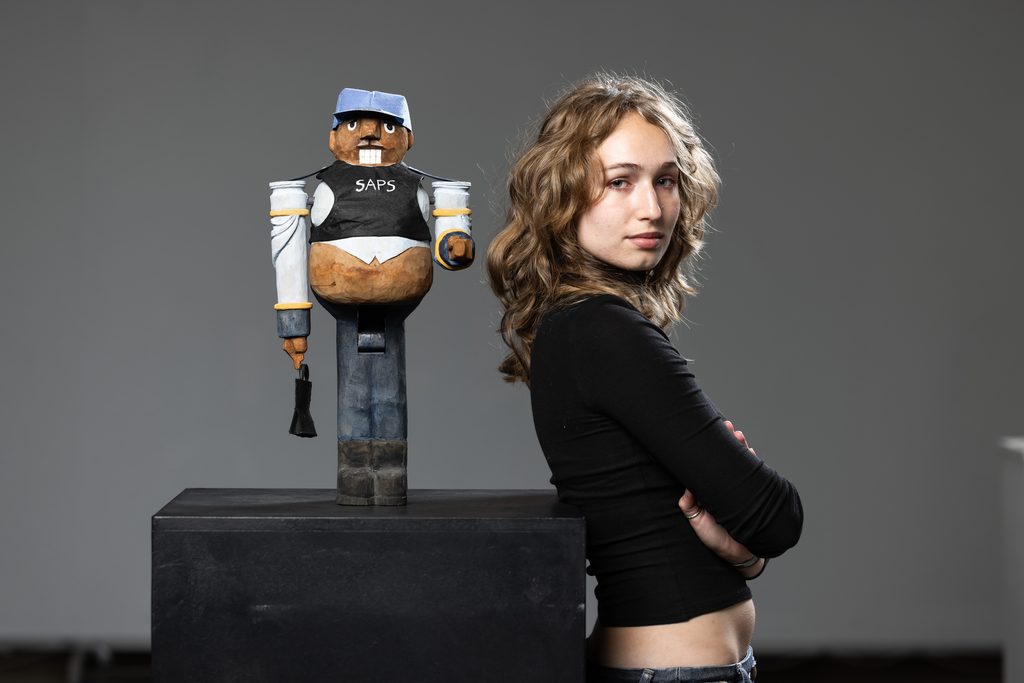
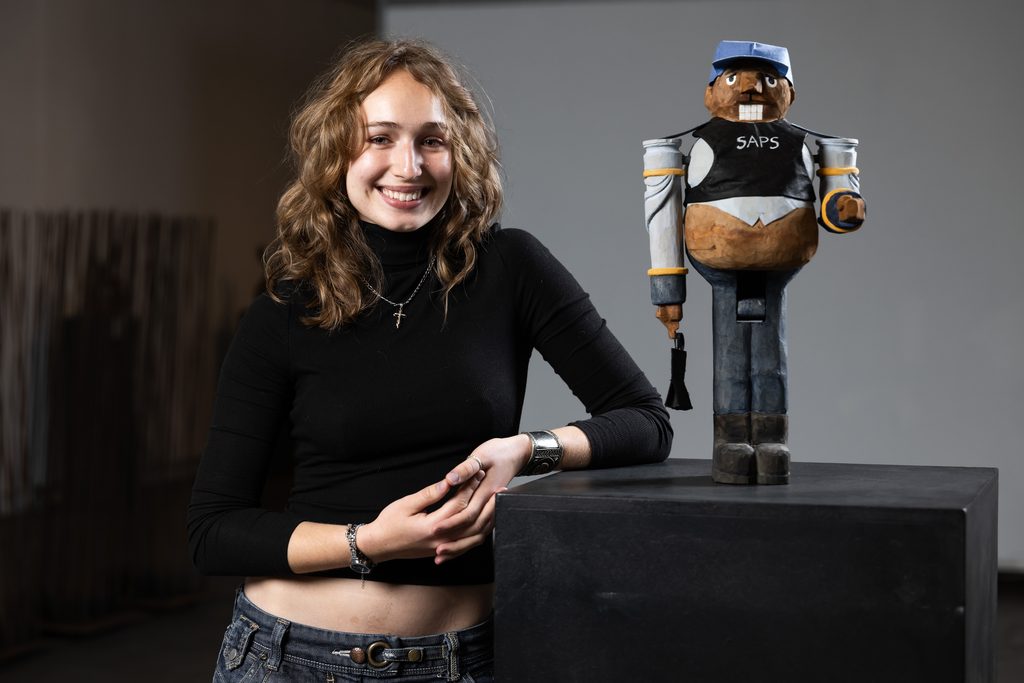
Ball buster, 2026
Mixed media
Artist Biography
Charlie de Bruto is a contemporary multidisciplinary artist based in Pretoria, Gauteng. Her work broadly focuses on the human condition, probing themes of memory, values, and personal narratives within societal contexts.
Her artistic approach is informed by her fascination with people and their everyday lives, which she observes with nuance and sensitivity. Her artistic process is often physically demanding, reflecting the strenuous nature of human experience. Working within charcoal, oil paint and etching, she investigates human behaviour and human impulse through trace and line – wanting to understand the human mind.
De Bruto is currently pursuing her BA(FA) third year the University of Pretoria.
Q&A
Tell us what your reaction was when you received the news that your work had been selected as one of the final 7 in the Sasol New Signatures Visual Arts Competition 2026?
I was in complete shock. I never expected to get into Sasol New Signatures to begin with, but then to be chosen as one of the final 7 completely blew my mind. I was extremely excited and have honestly been fighting the urge to not share this great news with my mum, my sister, my partner and all my friends and close family.
Is this your first time entering Sasol New Signatures? If so, what prompted you to enter? If not, how many times have you entered, and what keeps bringing you back to the competition?
No, this is not my first time entering Sasol New Signatures; however, this is my first time getting into Sasol. I entered once before in 2025. I think what brought me back to the competition was the opportunity to be a part of something great in the art world, something that gives artists a chance to showcase their work, build their careers and meet people in the industry.
As South Africa’s longest running art competition, what does being part of this competition mean to you at this stage of your artistic journey?
Being part of the Sasol New Signatures Competition is an important step in my journey as an artist. It is exciting to have my work recognised outside of the university environment and to have the opportunity to share it with a much wider audience. For me, it is also about gaining confidence in my practice, learning from the experience and seeing where my work can go from here. Being part of a competition with so many other emerging artists is a meaningful opportunity in developing my professional career and finding my place within the South African art community.
Tell us a little about your artistic journey to date?
Since 2022 I have done a few graphite, charcoal and oil painting commissions. Since the beginning of 2026, I have been really putting myself out there and becoming more involved in the art world. I had my first group exhibition in January at Terra Contemporary Gallery followed by two more group exhibitions – a micro group exhibition as part of the Tomfools Print Collective at Gallery 2-1 and an undergraduate group exhibition at Gallery 2-1. I also partook in my first fair with the Tomfools Print Collective in Cape Town which was an exciting opportunity to see a different side of the art world. Furthermore, as part of a joint community university project, I sculpted and cast a custom bat head for the Pretoria Ditsong Museum’s new displays. My latest and one of my most exciting works was an oil painting commission for the Embassy of Romania through the Portraits of Power programme run by the Charlotte Mannya-Maxeke Institute. And of course, getting into Sasol New Signatures 2026 with my wood sculpture.
Who or what has had the greatest influence on you as an artist, and how has that influence shaped your work?
My mum has been one of the greatest influences on me as an artist. As a little girl, I used to watch my mum paint and draw in our garage. I remember sneaking books away to trace and draw from because I so badly wanted to draw and paint like her. My mum is ultimately where my passion for art started. Her influence shaped my interest in people, figures and portraiture. I love figure drawing and find human beings fascinating. As my fascination with people grew, so did my interest in crime and trying to understand why people do the things they do. I am equally interested in and disturbed by human behaviour, and this has become a fundamental part of my work. I read and listen to a lot of disturbing and sad stories about things happening around the world that are caused by people. I constantly find myself trying to understand and deconstruct people’s thoughts, emotions and actions, while bringing awareness to these situations.
Tell us about your preferred medium or materials.
I love etching, charcoal and oil painting. Although they are very different processes, I am drawn to each of them because of how the physical qualities of these mediums support the ideas I explore. Etching is the medium most closely connected to my practice. I am interested in human behaviour, the human condition, crime and the traces people leave behind. The etching process itself is about leaving a mark, a trace that is bitten into the plate permanently altering it. I am drawn to how dark it can go, the detail that you can get and the limited control the acid introduces. The slow, physical process and accumulation of minute details create layers and depth. This mirrors the multifaceted nuances of the experiences and themes I investigate in my work. With charcoal, my interest is more for personal enjoyment. I particularly enjoy using it for figures and portraiture because of its rawness and mark-making. I like that it can remain immediate and imperfect rather than overly polished, and I enjoy its physicality, darkness and messiness. It gives me the opportunity to really capture someone in the moment as they are. Similarly, oil painting is also a medium I enjoy personally for figures and portraiture. I love how forgiving it can be due to the long drying times. This allows me to make changes and really focus on what I want detailed. It gives me the opportunity to experiment without every decision feeling permanent.
Tell us about the work you submitted. What inspired the piece, and what would you like viewers to understand or take away from it?
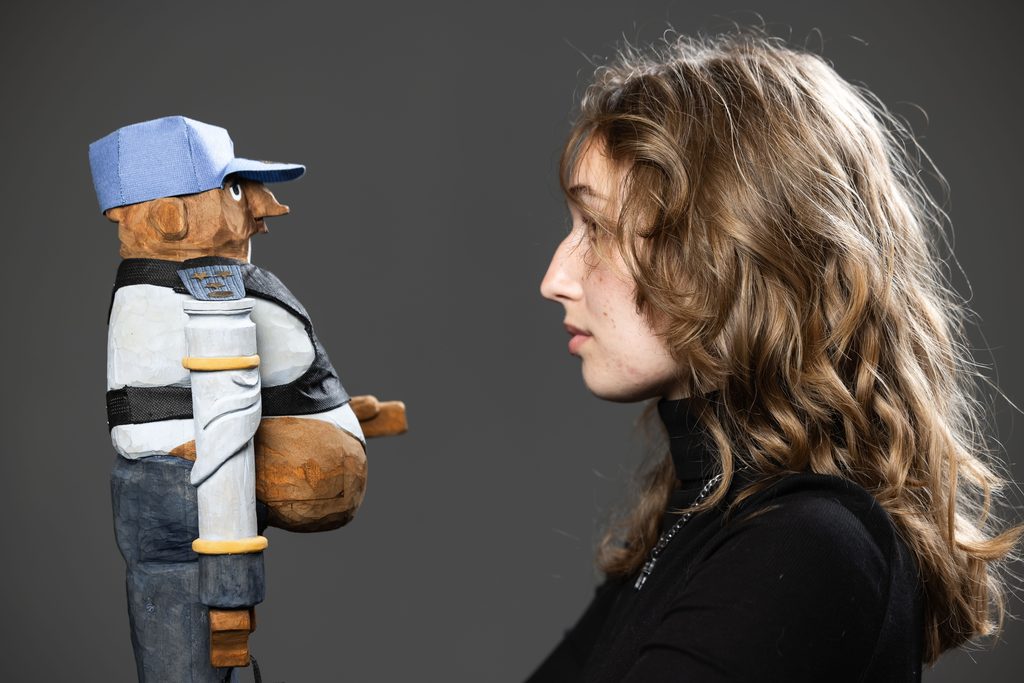
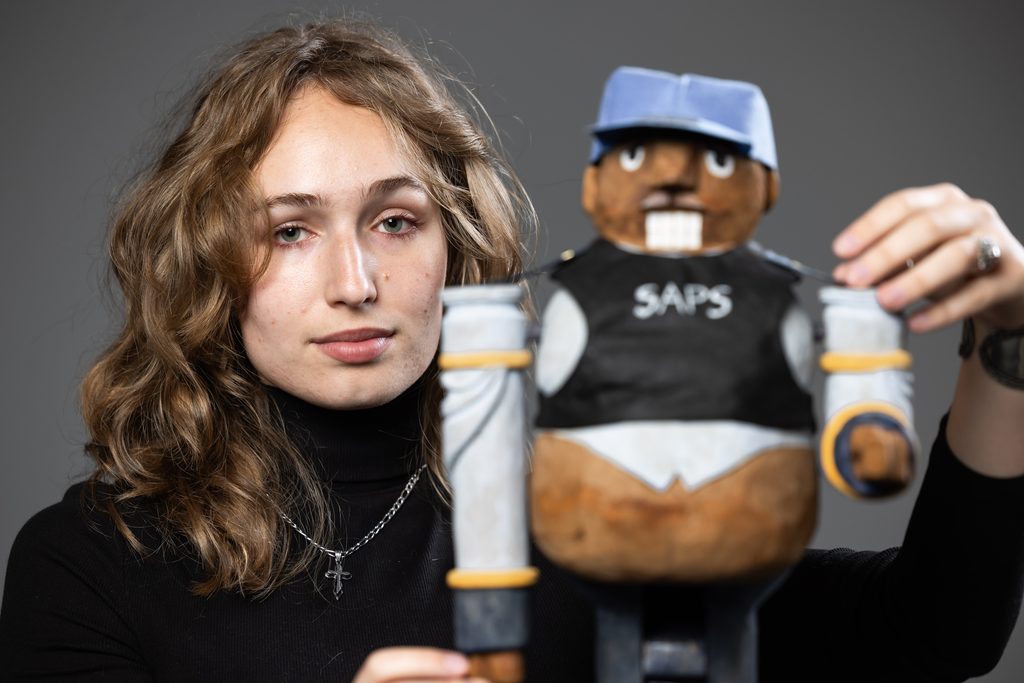
This work was inspired by the recent court case of Vusimusi “Cat” Matlala and feeling increasingly frustrated by what was revealed about power and accountability. I was interested in the contradiction between what the police uniform is supposed to represent (protection, authority and trust) and what happens when that authority is abused. Through a satirical portrayal I wanted to critique the stereotype of the South African “Bad Cop”, this led me to the nutcracker. Aside from my personal interest in nutcrackers, historically, they are symbols of protection, good luck and guardianship. Similarly, a police officer’s role is supposedly rooted in protection and public trust. The whimsical innocence associated with the nutcracker subverts the seriousness of the subject while drawing on imagery from the case. I don’t think there is one specific message I want viewers to leave with. I would rather the work make them curious enough to question what they are looking at. At first, Ball Buster can be funny or even ridiculous, but that reaction changes when the references begin to register. I want viewers to think about how easily power can become trivial, how corruption can happen in plain sight, and how the people we trust with authority are not necessarily beyond question.
Can you take us behind the creative process of the work you submitted? Was there anything unexpected, challenging or exciting that emerged while making it?
The making of Ball Buster was a big learning experience for me because it was my first time carving wood. I had to learn how to work with the grain, sharpen and use hand tools, and understand how the different pieces would need to fit together and move. I also had to teach myself how to assemble the sculpture, map out every piece, work with moving parts, paint the surface and hand-sew the smaller elements. One of the most challenging parts was learning to work with the wood rather than trying to force it to do exactly what I wanted. I had to adapt how I approached the carving while being careful not to break pieces off as jelutong Is a very soft wood. I found this really exciting because the work slowly developed through that process of problem-solving. It also made me appreciate the simplicity of carving by hand as most of my class used power tools, but not only did I love the look of a hand carved artwork but really wanted to learn the more traditional way of carving, especially because nutcrackers are traditionally made from wood. Seeing the sculpture move from a rough piece of timber into the final character was probably the most rewarding part of the process.
Which South African artists do you admire and why?
I admire several South African artists, particularly Diane Victor, Jane Alexander, Dylan Graham and Sarel Petrus. I am drawn to the different ways they use their chosen mediums and how their techniques contribute to the character of their work. Diane Victor is a major influence for me because of her etchings and the way she combines highly detailed mark-making with difficult and often confronting subject matter. I admire how the characteristics of etching strengthen the meaning and atmosphere of her work. I also admire Jane Alexander’s sculptural approach to the human figure. I find the contrastingly human and unfamiliar feeling of her figures particularly interesting, and the unsettling quality this gives her work. Dylan Graham is an artist I particularly admire for both his ink drawings and his approach to painting. In his drawings, I love how he builds an image through tiny marks, allowing them to accumulate into the subject. In his paintings, I am drawn to the way he seems to pull the subject out of the darkness of the canvas, creating a strong sense of atmosphere. Sarel Petrus is an artist I admire for his wood carving and sculptural work. I am particularly drawn to the physicality of carving and the way he brings expression and character out of the natural qualities of wood.
Being selected as a finalist can be an important stepping stone for an emerging artist. What are your hopes and ambitions for your practice beyond the competition.
My hope is to become a full-time practising artist after completing my studies and to build a sustainable career around my practice. I see being selected as a finalist as an important stepping stone towards this goal, giving me valuable exposure, experience and opportunities to connect with people in the art world. I also hope to build a market and audience for my work while continuing to exhibit, develop my practice and grow as an artist.
Where do you see yourself in 5 years and 10 years?
In five years, I see myself having completed or being close to completing my Masters. I am not entirely sure where yet, but I am not opposed to the idea of furthering my studies abroad. I want to travel and do residencies while establishing my own studio. I would love to have the freedom to travel and work from different places, even imagining a small live-in studio on wheels that would allow me to take my practice with me. In ten years, I hope to have established my visual language and be a full-time practicing artist with a huge, beautiful studio that I get to share with my partner. I hope to have exhibitions lined up and a home filled with the work I have created. I see myself still travelling from time to time for exhibitions while building a life with my partner and starting a family.


