

Artwork Details
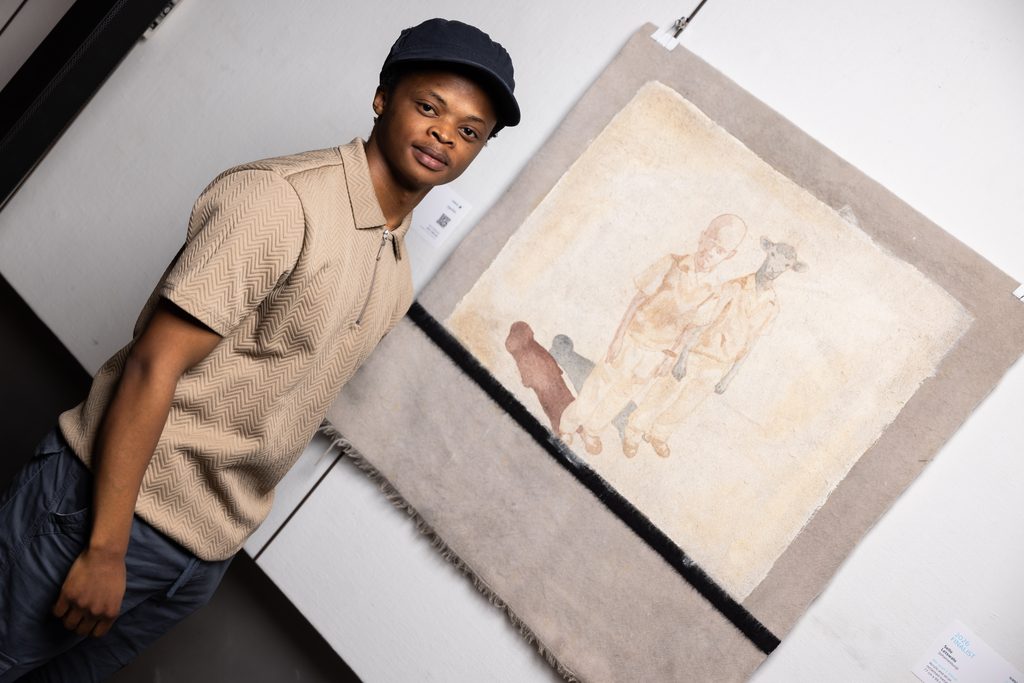
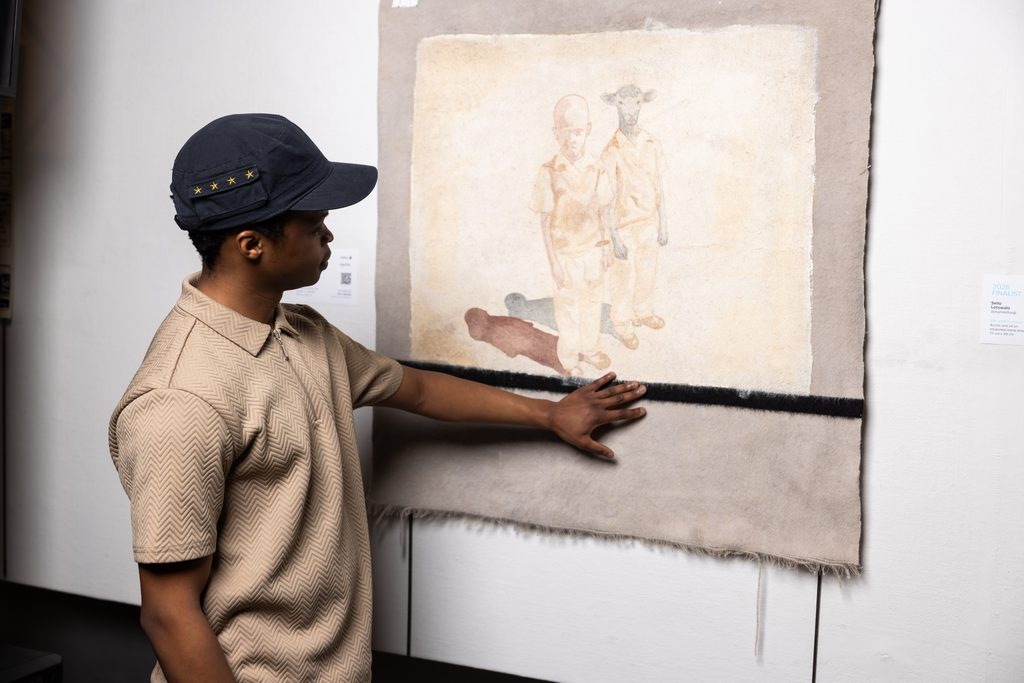
Umlandeli, 2025
Collected ochres and primer on blanket
Artist Biography
Sive Ntombana is a BFA graduate (with distinctions) and currently a Master of Fine Arts student at Rhodes University. He is a painter and mural artist currently based in Makhanda. Ntombana is the first prize recipient of the Eastern Cape Development Corporation (ECDC) Lithuba Lakho art competition 2025. Ntombana’s artistic interests are in postcolonial thought, indigenous knowledge systems, iintsomi (Xhosa folktales), Xhosa folklore, speculative fiction and folkloristic inquiry.
Ntombana has been involved in multiple street art projects; some have been part of the National Arts Festival curated programme. Ntombana has also been part of several group exhibitions, ranging from the Rhodes University student exhibitions at the National Arts Festival for four consecutive years. Ntombana was also part of the Eastern Cape Development Corporation (ECDC) Lithuba Lakho art competition’s exhibition of finalists, held at the Nelson Mandela Metropolitan Art Museum.
Q&A
Tell us what your reaction was when you received the news that your work had been selected as one of the final 7 in the Sasol New Signatures Visual Arts Competition 2026?
I was excited and grateful that my work was recognised as one of the top 7. Even now, it still feels surreal.
Is this your first time entering Sasol New Signatures? If so, what prompted you to enter? If not, how many times have you entered, and what keeps bringing you back to the competition?
This is my second time entering. What brought me back to the competition is how Sasol New Signatures, as a platform and support system, is able to expose emerging artists’ artistic ideas and beliefs at a national level.
As South Africa’s longest running art competition, what does being part of this competition mean to you at this stage of your artistic journey?
To be part of this competition is a big deal for me, as it is a big motivator towards my general artistic goals, which are to contribute to the Southern African artistic discourse and, one day, form part of the South African Art canon.
Tell us a little about your artistic journey to date?
My journey has been one that has demanded patience from me. Especially being an artist practicing within the Eastern Cape, as the is less opportunities compared to Johannesburg and Cape Town. But I have been treating this experience as a way to sharpen my artistic mind.
Who or what has had the greatest influence on you as an artist, and how has that influence shaped your work?
I am, firstly, very much inspired by the painting tradition that the likes of David Koloane, Patrick Mautloa, Louis Maqhubela, George Pemba, Ernest Mancoba and many others. This makes me understand and recognise whose shoulders I stand on.Secondly, I am influenced by my own upbringing; a lot of the themes and concepts I work with come from that upbringing.
Tell us about the work you submitted. What inspired the piece, and what would you like viewers to understand or take away from it?
The two works I submitted form part of a full body of work that contains 14 artworks as a whole. This work is informed by a philosophical approach. From this approach, I use Sihle Sogaula’s and Hugo Canham’s thinking of the Black Xhosa home as a space full of theoretical activity.
Within the work, I am trying to make sense of the notion of trauma and healing through a reflexive narrative perspective that is informed by theoretical thinking.
The takeaway from the work, I would say, comes in the form of a question, and that question is: How can South African Xhosa household (home)spaces, artistic practice, and embodied research contribute to theorising trauma and healing in African contexts? This question is not really meant to be answered but rather engaged with.
Tell us about your preferred medium or materials.
I would say my most preferred medium is oil painting, but ever since I started working with natural ochres, it has become exciting. Currently, I have been making my own oil paints with some of the ochres that I collect. But overall, I enjoy working with oil paint.
Can you take us behind the creative process of the work you submitted? Was there anything unexpected, challenging or exciting that emerged while making it?
The collecting of ochres and working with cultural materiality (ingcawe) has been interesting from my own painter’s perspective. As I was working with ingcawe, I had to think about its use as my canvas, and I also had to think about it not only as a canvas because it already has its own meaning and symbolism amongst amaXhosa. This then led me to dye the blanket with some of the ochres I collected and cut it in some instances. This then prompts questions around what it communicates alongside the subject matter once it has been altered from its initial state.
Which South African artists do you admire and why?
I admire ubra Patrick Mautloa; I like his fluid navigation of materiality as a painter. For me, he is able to keep that element of image-making in whatever material or medium he uses.
Being selected as a finalist can be an important stepping stone for an emerging artist. What are your hopes and ambitions for your practice beyond the competition.
I want to contribute to the Southern African artistic discourse and one day form part of the South African art canon.
Where do you see yourself in 5 years and 10 years?
I still see myself painting and a step closer towards my hopes and ambitions.
Anything final thoughts?
I would like to once again thank all the organisers of the competition, the judges, both regionally and the final judging panel, for allowing me the platform to push for my creative artistic ideas and for contributing a step closer towards my hopes and ambitions.


