

Artwork Details
Mixed media on cardboard and paper
Artist Biography
Sphumelele Zondi is a KwaZulu-Natal-born visual artist based in Johannesburg, South Africa, working primarily in sculpture and mixed media. Her practice investigates memory, childhood nostalgia, and the relationship between past and present through sculptural forms constructed from mixed media on cardboard and paper. Rooted in community and the broader South African landscape, her work engages with personal and collective histories, exploring inherited narratives, resilience, and the emotional traces embedded within places, objects, and everyday materials.
Zondi holds a Bachelor of Visual Arts from the University of KwaZulu-Natal and a Postgraduate Diploma in Fine Art from the Durban University of Technology. She has worked as a studio assistant and artist assistant in Durban, gaining practical experience within professional studio environments and contributing to the development of contemporary ceramic and sculptural practices. She also completed an internship with the Constitutional Court Art Collection, where she engaged with the intersections of art, justice, and public dialogue. Alongside her studio practice, research and storytelling and curatorial thinking inform her approach to sculpture, deepening her engagement with memory, history, and material culture. Her work is grounded in an ongoing exploration of how materials can function as carriers of narrative, transforming familiar substances into forms that reflect complex human and social experiences.
Through sculpture, Zondi creates spaces for reflection, inviting audiences to consider how memory is embedded in everyday life and how it continues to shape contemporary South African experience.
Q&A
Tell us what your reaction was when you received the news that your work had been selected as one of the final 7 in the Sasol New Signatures Visual Arts Competition 2026?
I honestly could not believe it. I was overwhelmed with joy, excitement, and at the same time shocked. Sasol New Signatures is such a big and highly competitive competition, so making it this far and being selected as one of the final 7 is a dream come true. I also felt incredibly proud of myself and the work I’ve created. Taking the leap to apply for such a prestigious competition for the first time was already a big step for me, and to now be among the final 7 is something I never imagined. I was truly grateful and couldn’t believe that my work had brought me this far.
Is this your first time entering Sasol New Signatures? If so, what prompted you to enter? If not, how many times have you entered, and what keeps bringing you back to the competition?
Yes, this was my first time entering the competition. What prompted me to enter Sasol New Signatures was the incredible opportunities and exposure it provides to young emerging artists. I first became aware of the competition during my university years, and this year I felt ready to take that step and put my work forward. I entered because I wanted an opportunity to showcase my work to a wider audience, begin establishing myself as an emerging artist, and create a presence for myself within the art world. Sasol New Signatures holds such great significance in the South African art space and I saw the competition as an important platform where my work could be seen and engaged with.
As South Africa’s longest running art competition, what does being part of this competition mean to you at this stage of your artistic journey?
Being part of Sasol New Signatures at this stage of my artistic journey feels like a significant milestone. The opportunity to be recognised within a competition with such a long-standing history in South Africa’s art landscape is both meaningful and affirming. It gives me the opportunity to place my work within broader artistic conversations, engage with other artists, and reach audiences beyond my immediate circle. More than recognition, I see this experience as a valuable step towards defining my practice as well as creating a stronger foundation for my career as an artist.
Tell us a little about your artistic journey to date.
My relationship with art began long before I understood it as a career or a discipline. Growing up in a rural environment where formal access to the arts was limited, creativity existed in everyday life; in play, observation and the ways communities passed knowledge from one generation to the next. Looking back, I recognise these experiences as the foundation of my artistic practice.
My formal art education began in high school, where I was introduced to drawing and a range of visual art mediums. This curiosity later led me to pursue a Bachelor of Visual Arts, where I explored printmaking, digital art, drawing, and sculpture. While studying, I found myself increasingly drawn to three-dimensional forms, particularly ceramics. Growing up in a rural environment, much of our childhood was spent making things, building, shaping, and playing with the materials around us. Although I did not identify these experiences as artistic at the time, they cultivated an early understanding of form, touch, and materiality. Ceramics became a continuation of that relationship, allowing me to transform a familiar act of shaping clay into a contemporary artistic language. Through vessels, organic structures, and figurative forms, I began investigating themes of humanity, memory, and human experiences.
After graduating, I worked as an artist assistant for Durban based artists where I gained practical experience within professional studio environments and and further developed my understanding of ceramic practice. Beyond the studio, this period exposed me to a different pace of city life and a wider artistic community through conversations and people from diverse backgrounds, I expanded my understanding of contemporary art and its relationship to everyday life. It was also a time of observation and research, allowing me to encounter creativity beyond formal art spaces and to recognise how art exists within the streets, communities, and lived experiences of people.
A significant shift in my practice occurred during my postgraduate studies when I transitioned from clay to mixed media on cardboard and paper. Moving from a material associated with weight, permanence, and durability to one characterised by fragility and impermanence transformed the way I approached making. What initially appeared to be an ordinary material soon became central to my artistic language. This transition was not simply a change of medium, but a psychological and conceptual shift shaped by both personal experiences and the shared experiences of those around me. Where clay often carried a sense of weight and burden, paper offered a different possibility; one of openness, vulnerability, and re-imagination. I became interested in how a fragile material could hold difficult histories, memories, and social realities while simultaneously creating space for healing, reflection, and optimism. Through paper sculpture, I found a medium capable of expressing complex narratives about humanity. The act of cutting, shaping, folding, and reconstructing paper became a way of revisiting experiences that were once marked by fear, uncertainty, or pain, and transforming them into forms that invite dialogue and contemplation.
My work often draws from personal and collective histories, exploring childhood, home, rural experiences, and the emotional landscapes that shape our lives. I create sculptural forms that move between the figurative and the symbolic, using everyday objects and materials as vessels for storytelling. Through these forms, I reflect on social realities, and the ways in which individuals and communities navigate change, working with human figures or familiar objects.
This approach was further enriched through my experience as an intern with the Constitutional Court Art Collection where I encountered the powerful intersections between art, memory, justice, and public dialogue.
Today, my practice exists between sculpture, material exploration, research, and storytelling. Through my work, I seek to create spaces for reflection and connection, using materials not simply as objects of construction but as carriers of history, and human experience. I am interested in how art can offer new ways of understanding ourselves and the world around us.
Who or what has had the greatest influence on you as an artist, and how has that influence shaped your work?
The greatest influence on me as an artist has not been one particular person, but the many people and experiences I have encountered throughout my artistic journey. My development has been shaped by lecturers, fellow artists, collaborations, conversations and critiques I have received along the way. Each of these encounters has contributed something different to the way I approach my practice.
During my studies, my lecturers played an important role in shaping the way I think about art. Their influence extended beyond teaching techniques or artistic processes but they challenged me to question my decisions, to think critically about the ideas behind my work and to understand that making art is also a process of research and reflection. Critiques were particularly important because they taught me how to listen to different perspectives while also learning to defend and understand my own decisions.
Other emerging artists have also influenced my practice through the ways in which they approach materials, concepts and their own personal histories. Friends and family encouraged me with advice and compliments. Encountering different practices has made me to remain open to experimentation and to understand that there is no single way of approaching an idea. Conversations with people have often introduced me to ways of thinking that I would not have arrived at independently. My artistic voice has therefore developed through a continuous exchange between my own experiences and what I have learned from the people and artistic communities around me
Tell us about your preferred medium or materials.
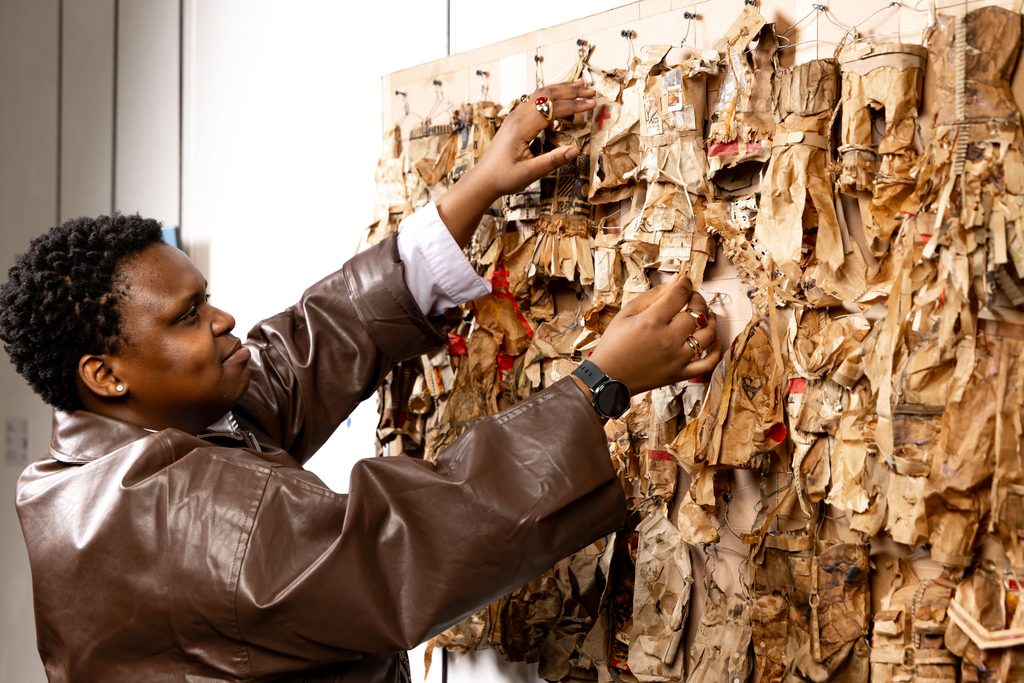
My preferred medium is working primarily with mixed media on paper and cardboard. I am drawn to these materials because they are ordinary, accessible, and often overlooked, yet they hold an incredible capacity to be transformed. Much of the paper and cardboard I use comes from discarded packaging, grocery boxes, franchise packets and materials that would otherwise be thrown away.
I see paper and cardboard as materials that embody both fragility and strength. They can tear, collapse but also be moulded, reinforced, and transformed into something that holds its own weight. The material gives me a physical language through which I can think and speak. I can also manipulate it through folding, cutting, burning, painting/writing, while incorporating layered materials such as wire, newspaper, prints and other found elements. Each process changes the material and leaves a trace. I see these traces as important because they allow the material to carry evidence of transformation, much like people carry the marks of what they have experienced.
What excites me most is the ability to take something considered disposable and give it another life and another meaning. I use these materials to construct sculptures that become vessels for conversations about history, survival, and the realities of everyday life. The material is therefore not separate from what I am saying, it is part of the language of the work. I want viewers to recognise something familiar in the material, but encounter it differently, and to question what we overlook, what we discard, and what can still be transformed.
Tell us about the work you submitted. What inspired the piece, and what would you like viewers to understand or take away from it?
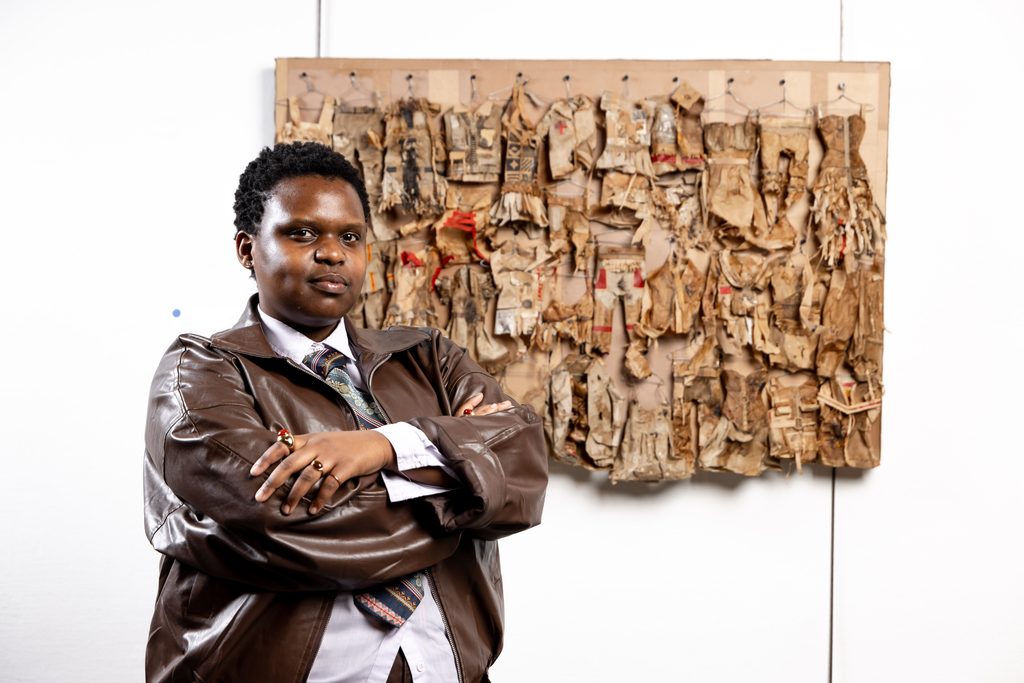
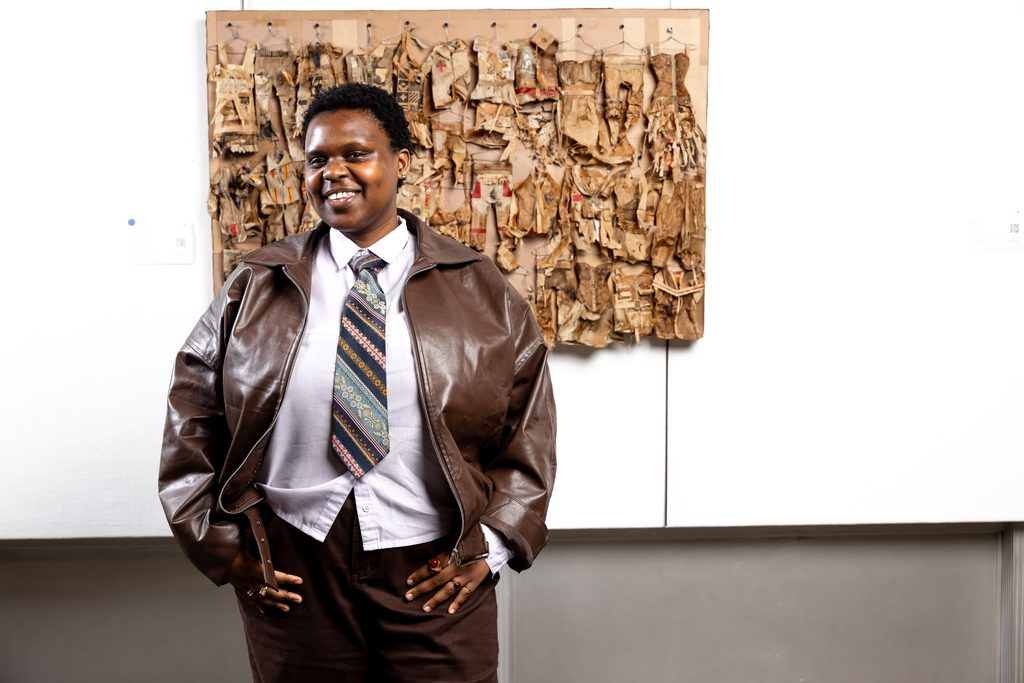
The work I submitted, The Laundry of a Nation, speaks about the social and emotional inheritance carried by young people in South Africa. It was inspired by a personal and broader questioning of what is passed down to us, influencing how we see ourselves, how we behave, and how we imagine our futures. I began thinking about the realities and social struggles that shape our lives as young people and become interested in how these conditions become part of our homes and shape our country.
The work draws attention to clothing that carry these experiences, traces of labour, care, hardship, and survival that can become embedded within them. I was also interested in the idea of Abantu bazothini? the awareness of being watched, judged, or questioned by others, and how this can influence young people from an early age.
Through the work, I want viewers to reflect on what they have inherited from generations and circumstances before them, and to question what they are now carrying forward. I want the piece to encourage a remembrance of our history while also asking difficult questions about the present: What has changed? What continues to be repeated? What are we passing on to the next generation?
Can you take us behind the creative process of the work you submitted? Was there anything unexpected, challenging or exciting that emerged while making it?
The creative process was very hands-on and required a great deal of patience, particularly because of the scale and detail of the work. One of the biggest challenges was creating clothing at that small scale. Each garment required details that would make it feel recognisable and believable, I had to shape and mould paper intentionally while gluing very small pieces. Working at this scale meant that even the smallest detail could change the character of the piece.
Another challenge was creating clothing that appeared as though it was being worn by an actual person. I was not working from a human figure or a fixed mould, so I had to imagine the proportions and construct the form from my own understanding of the body. I had to constantly consider how fabric falls, where it folds, how a sleeve sits, or how a pair of trousers would hold its shape when worn. This made the process difficult, but it also made it very exciting because I was essentially creating the body through the clothing without physically representing the person. An unexpected part of the process was discovering that not every garment needed to come from an existing reference. I might begin knowing that I wanted to create a particular type of clothing, but as I worked, the material would lead me somewhere else. I found myself creating garments and designs that do not necessarily exist, but still feel familiar. This allowed my imagination to become part of the making process and gave the work a sense of possibility.
Burning the paper was another process that introduced an element of unpredictability. Sometimes the flame would travel further than I intended or alter the material in a way I could not have planned. Instead of always treating these moments as mistakes, I became interested in what they produced, all the unexpected textures and marks. Ultimately, the process became a balance between knowing what I wanted to make and allowing something unexpected to emerge.
Which South African artists do you admire and why?
The South African artists I admire are Noria Mabasa (1938-), Jane Alexander (1959–) and Dumile Feni (1942–1991). These well-known artists have inspired me to this day through their unique approaches to art creation and the meaningful stories they communicate through their work. However, I will focus specifically on Dumile Feni and his influence on me.
I admire his work because he used both two-dimensional artworks and sculpture to tell powerful stories about the experiences of Black South Africans. His figures often communicate suffering, displacement, oppression as well as resilience, allowing the human body to become a powerful way of expressing social and political realities. His two-dimensional works are particularly striking because of the expressive way he represented the human figure. His drawings and prints often contain elongated, distorted and emotionally charged figures, which give them a sense of vulnerability and pain. Rather than simply portraying people realistically, he used the distortion of the body, his figures can therefore be understood as representing not only individuals, but also the broader struggles of Black people under apartheid.
I also admire his sculptural forms, his knowledge of proportion and gesture allowed him to communicate emotion through the physical structure of the body. There is a connection between his sculptures and his two-dimensional works, as both reveal his interest in expressing the psychological and social condition of his subjects through the human figure. What truly makes Dumile Feni important to me is that his art gives visibility to stories and experiences that were often marginalised which are themes I get drawn to even in my own work and use of my materials. His work is deeply human and emotionally powerful, while also reflecting the political realities of his time and admiring dignity and resilience of Black South Africans.
Being selected as a finalist can be an important stepping stone for an emerging artist. What are your hopes and ambitions for your practice beyond the competition?
Being selected as a finalist is a huge opportunity for recognition and growth within the art space. For me, it is an important affirmation of my practice as an emerging artist and an encouragement to step further into the art world with confidence. Beyond the competition, I hope to establish myself as an artist, continue developing my practice, and share my work with wider audiences. I would like to be part of more group and solo exhibitions, create commissioned work, engage and collaborate with other artists and creative spaces. Most importantly, I hope to keep making work that allows people to experience, connect and engage with my ideas and practice.
Where do you see yourself in 5 years and 10 years?
In five years, I see myself becoming more confident and grounded in my practice, with a clearer understanding of my ideas and the confidence to take some of the works and concepts that are currently in my sketchbook and bring them into reality. I hope to be actively practicing and exhibiting, while collaborating with other artists, galleries and other creative spaces. I would also like to travel to different cities and countries, experience other artists and their work, and allow those experiences to influence and expand the way I think and create. I want to be grounded in my concepts, but still leave room for flexibility, experimentation and change.
In ten years, I hope to look back and see a practice that has grown beyond just my own making. I would like my work to create a sense of freedom for both myself and the people who experience it, giving people space to think, feel and perhaps free themselves psychologically in some way. I also want to share what I have learned with other emerging artists who may be in the position I am in now. Working with children is another part of that future for me. Through workshops, I would like to make art feel accessible and exciting for them. I have already been volunteering in my community and city with registered foundations and NPCs, and I hope to grow this into a meaningful part of my practice. Ultimately, I want to keep creating, keep learning and remain open to where my work takes me.
Should you be selected as the overall winner – Do you have an idea of what your first solo exhibition would look like?
If I were selected as the overall winner, I would want my first solo exhibition to be a space where I can really engage with different themes and ideas that have been sitting with me for some time. One idea I have thought about and imagined developing is around demystifying the idea of inheritance, especially the way we understand it as something that is automatically good. We often hear that we inherited something from our parents and it sounds like a gift, something valuable that we receive and carry with us. But I am interested in the other side of that. What about the things we inherit psychologically? What about the behaviours, experiences, fears or ways of thinking that come from our families? What about the things we inherit from the country we are born in, its history, culture and circumstances? Is inheritance a concept we only acknowledge when what we receive is good?
These are questions that keep opening up more ideas for me, and I would really like to engage with them through my solo exhibition. I would want the exhibition to bring together different parts of my practice that I did not use for this competition.
My work includes sculptural figures that combine human and animal forms, objects that resemble ordinary/ everyday items found in the home and familiar spaces, which I transform to reflect different aspects of the human experience. I would also create sculptural landscapes that depict scenes/ environments, exploring both physical spaces and more spiritual or psychological spaces. I would like to bring these works together in a way that invites people to engage with them both physically and emotionally. They would sit alongside the ‘Inheritance’ concept, creating a space to explore different aspects of the human experience, what we carry with us, and how these things shape who we become.
Any final comments?
Being selected as one of the Top 7, especially as a first-time participant, has honestly felt unreal to me. It has shown me that there is something I can offer within the art space and has given me even more belief in my journey and sharing my work with the world. I am grateful for the recognition and for the opportunity to be seen at this stage of my practice. It has encouraged me to keep creating, keep learning and continue moving closer to the artist I hope to become.


